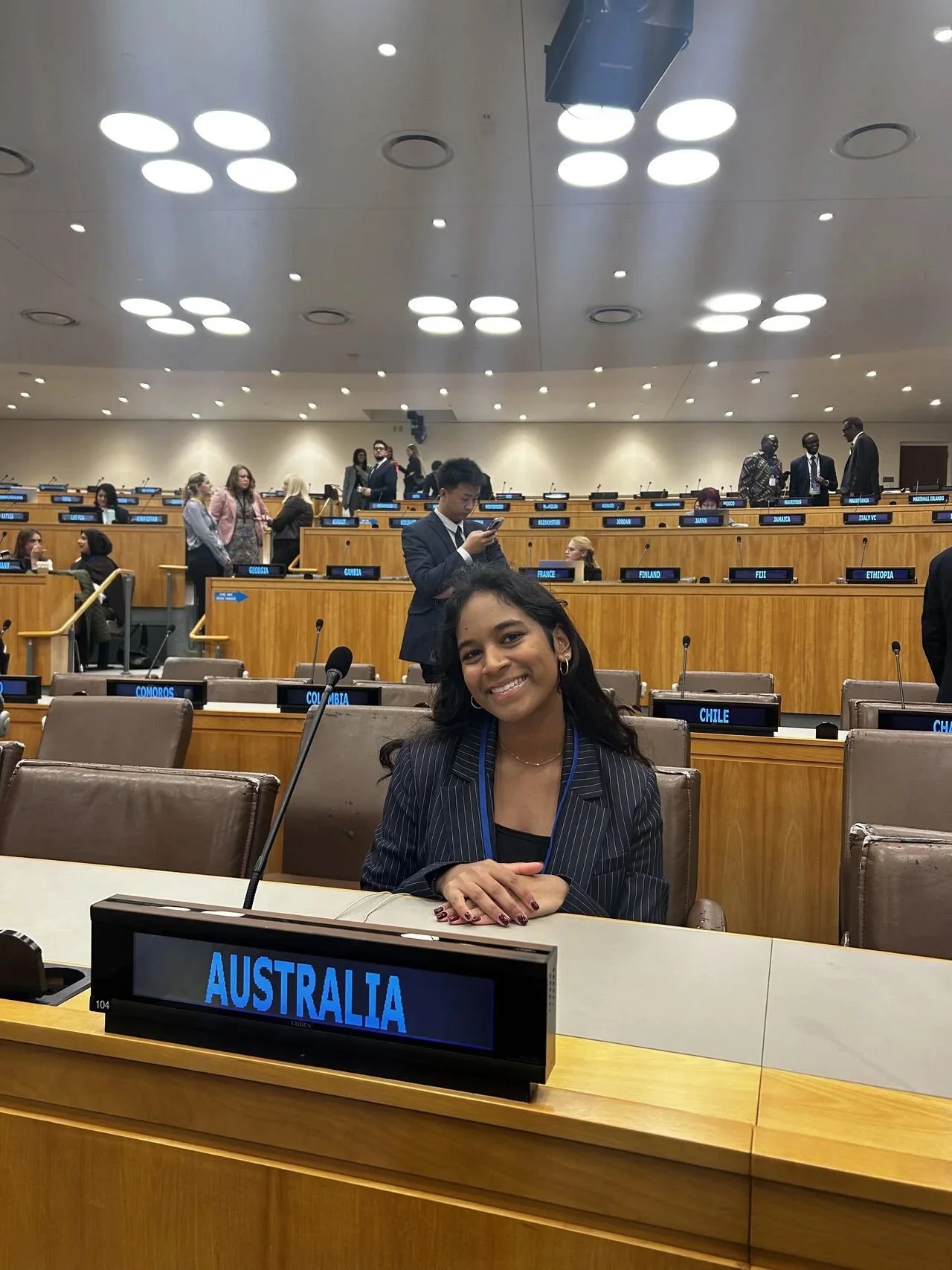
A Home Handed Down In Stories
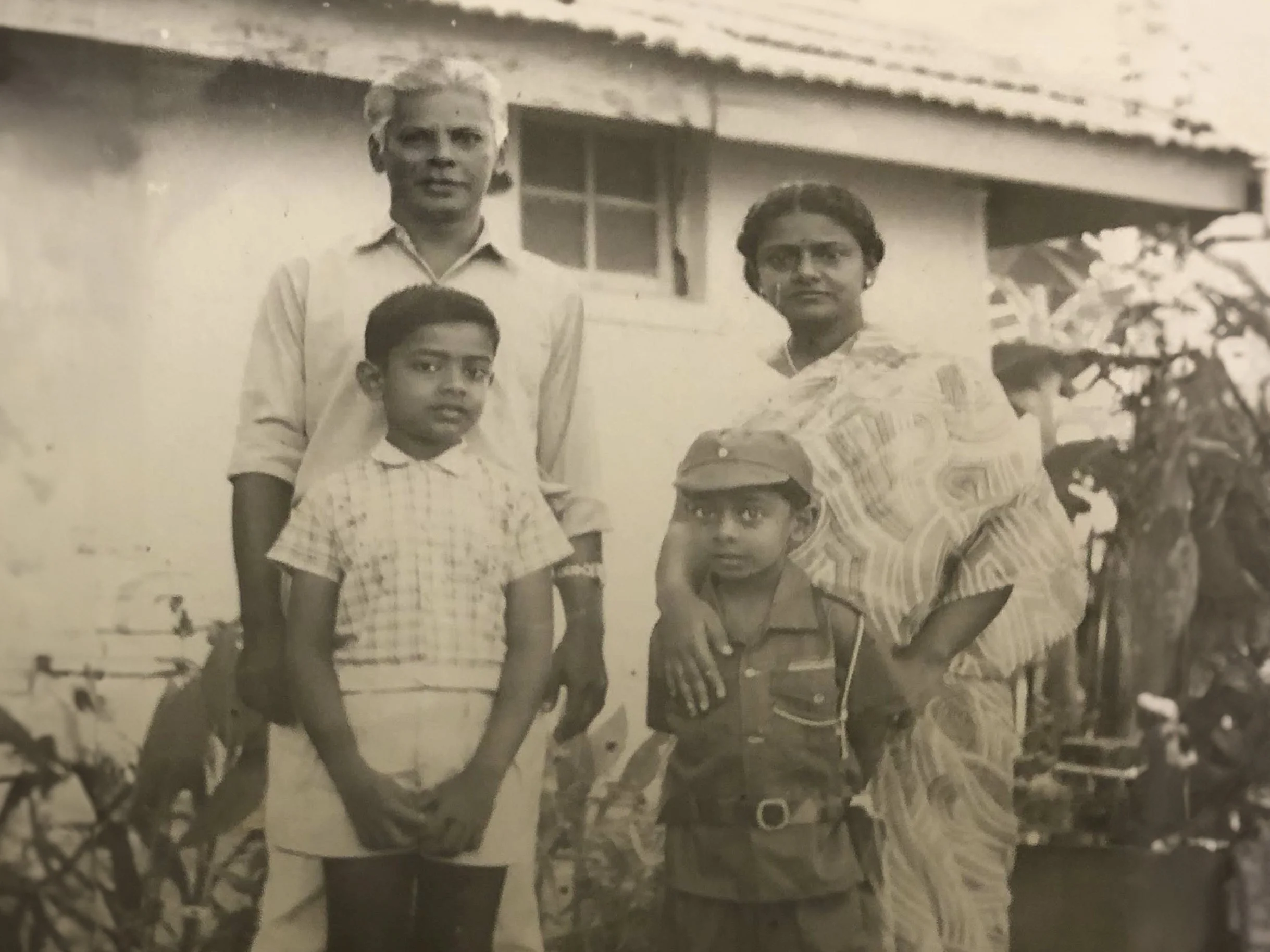
Satara’s father (left) as a child with his family near their childhood home
Travelling to Sri Lanka, Satara Uthayakumaran searches for a home she inherited only through stories. As the daughter of survivors of the civil war, she confronts the remains of her family home – tracing bullet holes, bombed rooms and the remnants of her father’s childhood to assemble a history that shaped her life but never fully felt like hers.
In Sri Lanka, the first things you notice are the dogs. They roam the streets with a peculiar, jagged ownership of the tarmac, ribs pressing against tawny fur, their ears bitten and torn. They are living artefacts of a violence that seems to hang heavy in the humid air, suspended like dust motes in a shaft of light. They watch you with eyes that have seen too much – sentinels of a history that refuses to stay buried, patrolling the boundaries of the past and the present.
Then, you see the walls.
In 2023, at twenty years old, I travelled to this island to find the setting of the stories I was raised on. It was my first time returning alone with my father – and our first journey north to Jaffna, where he grew up. As the daughter of survivors of the Sri Lankan Civil War, I grew up in a home constructed not of bricks but of words.
I had heard about my grandfather, a doctor who treated people even as the war closed in, tending to the wounded with a quiet, steady hand. I carried that legacy with immense pride, imagining him as a pillar of a community that no longer exists. I heard about my grandparents’ house – a home that once welcomed everyone, its doors always open. I was told stories of the days when the rooms buzzed with conversation and of my grandmother making pineapple wine that tasted of the golden afternoons.
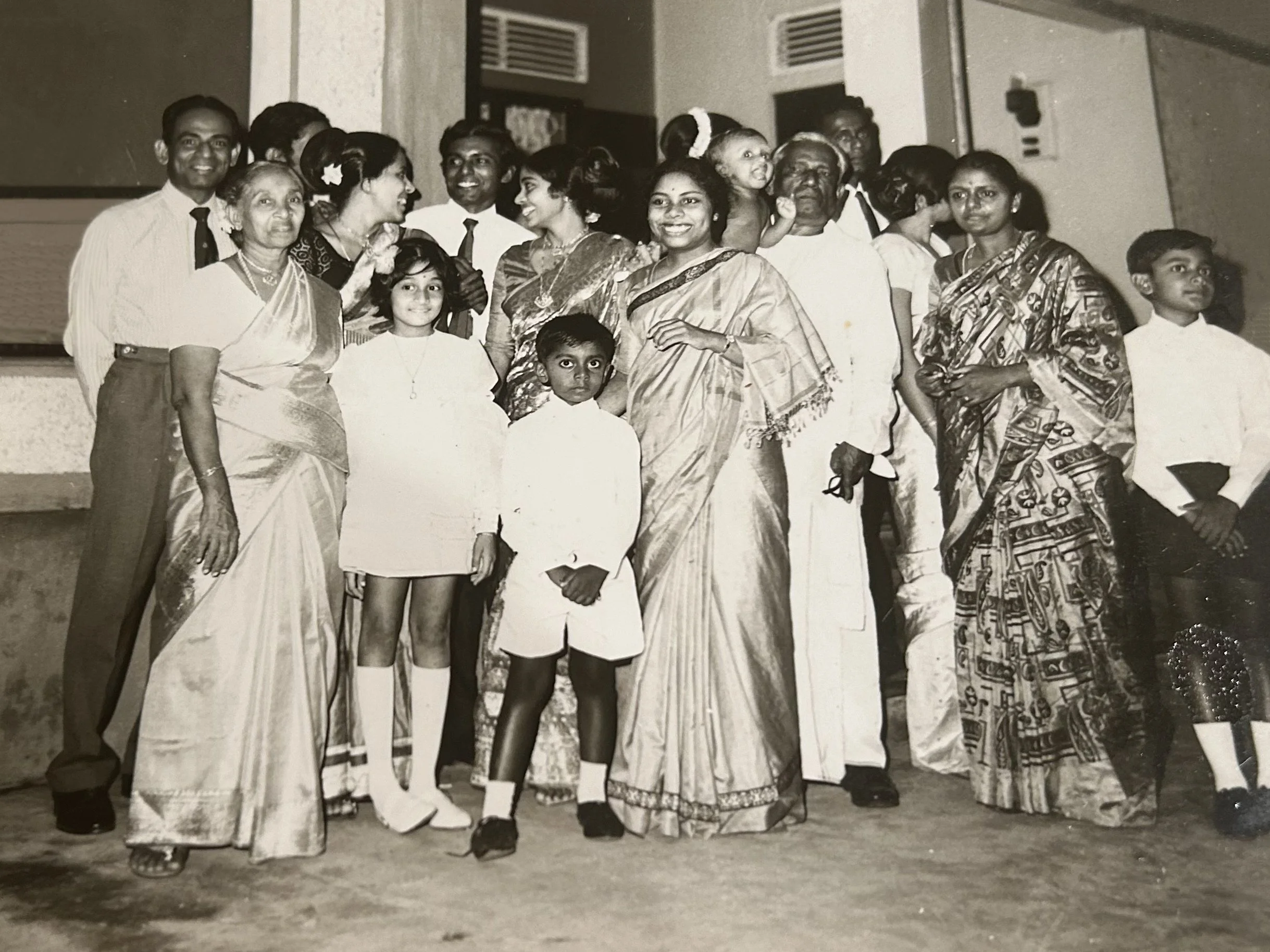
The faces behind the stories of home
But standing there in that same family home I was visiting for the first time, the silence was deafening. The reality did not match the fable. The laughter was gone; the smell of pineapple wine had long since evaporated.
The porch of my father's house had been painted a startling, vibrant green. It was a chaotic, hopeful colour, applied thick and fast – evidence of an attempt to paint over the past, to reclaim the structure from the decay of memory. But the paint was a thin skin. Beneath that bright veneer, the concrete was still pockmarked with bullet holes. They were scars that had been dressed up but never healed, the indentation of impact still visible if you ran your fingers over the masonry like braille. It was a cosmetic fix for a structural wound; a bright bandage on a broken limb.
This journey was supposed to be a homecoming but how do you return to a home you never knew?
I walked through the rooms where my grandparents lived – grandparents whose voices I never heard, whose embrace I never felt. The house was a skeleton of its former self. The air inside was still and heavy, preserving the silence left behind by those who fled. I stared at the empty spaces where life used to happen – the corner where a chair might have sat, the wall where a calendar might have hung. Their faces are known to me only through creased, black-and-white photographs that we keep like holy relics, evidence of a lineage that the war tried to erase.
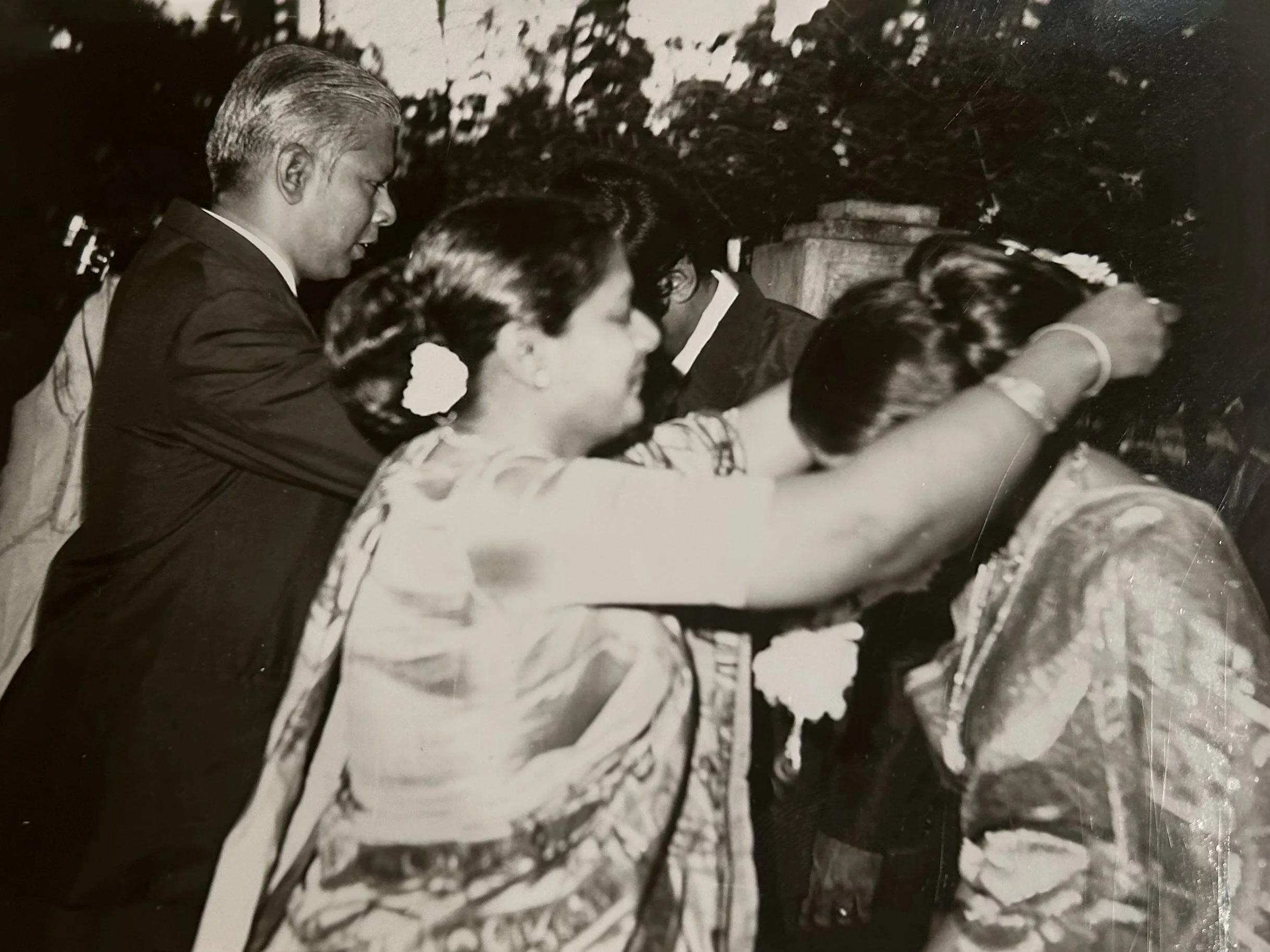
Satara’s family in a moment of celebration
Then I came to the room that had been bombed out.
The door was fused shut, jammed by debris and years of shifting foundations. But through a gap at the bottom, I could see into the gloom. Driven by a simple, childish curiosity – a need to see what lay in the dark – I flattened myself against the cool, dusty floor. I pushed my small body through the gap beneath the locked door, scraping my skin against the ruin to get inside.
I stood up in the dim light, coughing slightly in the dust and just looked. I wasn’t searching for anything specific; I was scavenging, scanning the floor for any scrap of history, any evidence that my family had actually existed here amongst the rubble.
That was when I saw them.
Scattered across the floor were pieces of my father’s chess set – wooden knights and pawns, coated in the thick dust of a collapsed roof. Finding them felt like a physical blow. Here was a game of pure strategy and logic, a game of clear rules and defined movements, abandoned in a place where reason had long ago been extinguished. I knelt and gathered them up, gritty and solid in my hands, retrieving a small piece of order from the chaos.
The geography of this return is complex and painful. It is an interrogation of belonging.
I was a tourist in my own ancestry, an observer of the aftermath. The trauma of war doesn’t just end with a ceasefire; it trickles down generations, changing the very architecture of our families. It leaves us – the children of our parents – to construct a sense of home not from foundations but from fragments.
We build our identity from the debris: the stories of a doctor who healed the wounded, the taste of pineapple wine we never drank and the physical remnants of a war we didn’t fight but still carry. We build it from a coat of green paint trying to hide the bullet holes, from a rescued chess piece in a dusty hand and from the phantom memories of a life that might have been.