Growing Up Othered: Letters From Young Australians
Photo credit: Kamila Maciejewska
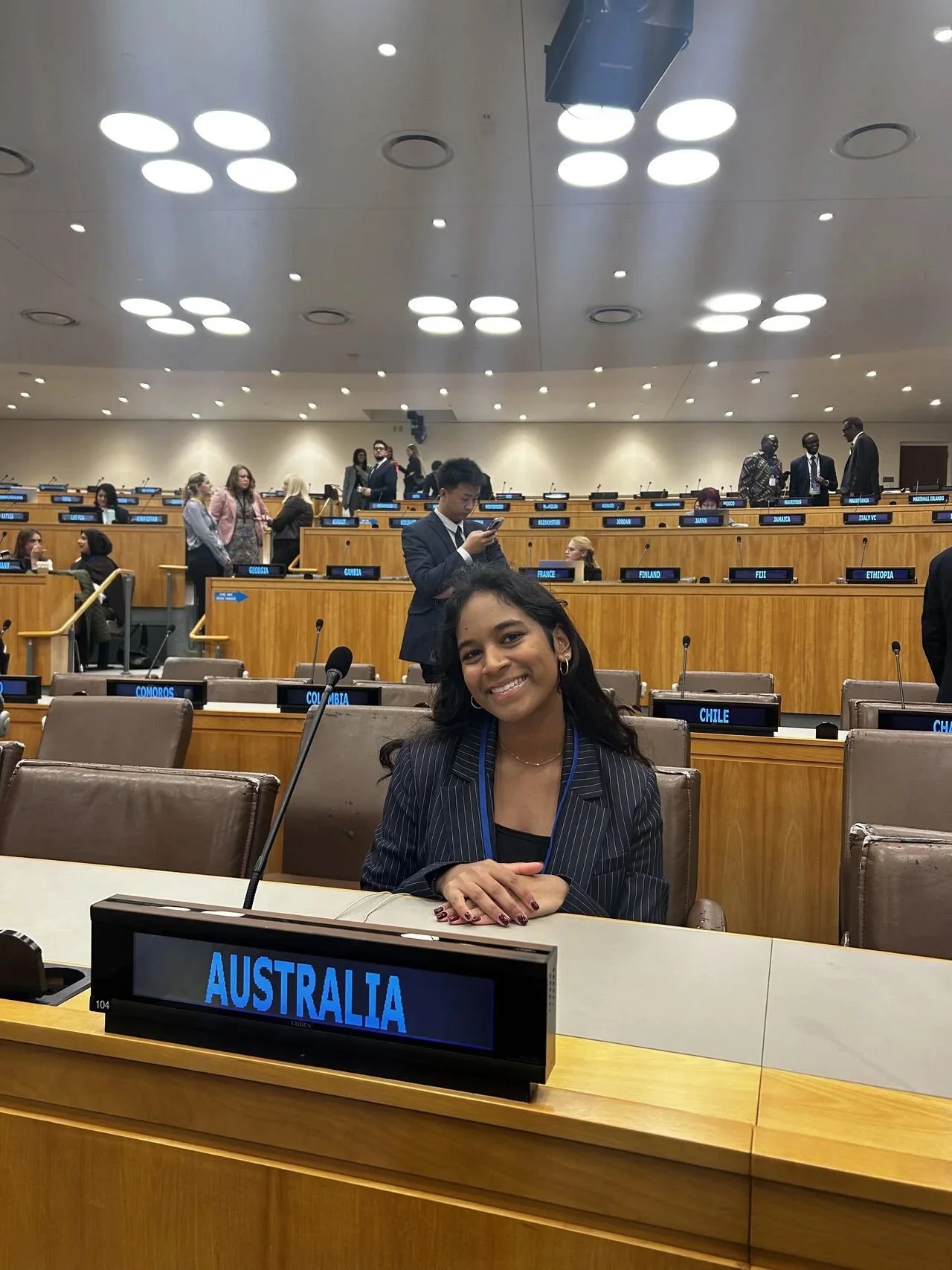
Writer and storyteller Satara Uthayakumaran reflects on the thousands of letters entrusted to her during her time as Australia’s Youth Ambassador to the United Nations. Carrying the voices of children across Australia, this essay asks what happens when belonging is questioned – and what listening truly demands.
“I wish people would stop asking me where I’m really from.”
The sentence was pressed hard into the page, the pen almost tearing through the paper.
There was no greeting, no signature flourish. Just a sentence that felt exhausted from having to exist. I read it again, then again, aware that the force behind the words carried far more weight than their length suggested. It came from a letter written by a 13-year-old girl from Ballarat who was tired of being questioned, tired of having to explain herself, tired of defending a belonging that should never have been up for debate.
Last year, I was appointed Australia’s Youth Ambassador to the United Nations. My task was simple in theory but much more demanding in practice: to listen. To journey across the country, from bustling cities to remote outposts, meeting young people from all walks of life and carrying their stories to spaces of power that rarely hear them directly.
Across my “Listening Tour,” I met more than 5000 young Australians – speaking with those who had endured prison, survived forced marriages and modern slavery. I listened to children with disabilities who feel invisible in systems not built for them and to young people from First Nations communities still fighting to be heard in their own land. From Tasmania to the Tiwi Islands, from suburban classrooms to detention facilities, the diversity of experiences is vast – but the underlying desire is strikingly consistent.
To be seen. To be safe. To belong.
The letter I received from that 13-year-old girl was one of thousands I carried with me across the nation during my time as Australia’s Youth Ambassador. Folded into notebooks. Scribbled onto loose paper. Whispered to me after school assemblies, slipped into my hands in detention centres, offered quietly as if the act of sharing itself was risky.
And in those letters, I heard the same thing – children crying out to be heard in a country that often speaks over them.
A 14-year-old boy from Ashley Youth Detention Centre in Tasmania wrote:
“The police locked me up because they couldn’t communicate with my mum who didn’t speak English. When they took me away, she was terrified because she thought I was being deported to my home country.”
Another 14-year-old – a girl, this time, from Sydney reflected on her fear of the anti-immigration March for Australia protests:
“It didn’t matter where you lived – suddenly it felt like nowhere was safe for people like us.”
And as a 10-year-old girl in Victoria simply put:
“I destroyed so many parts of my identity to fit in.”
These were fragments of a larger truth about what it feels like to grow up marked as “other” in a country that proudly calls itself multicultural.
Australia’s multicultural story is often told as a success. We point to our diversity, our food, our festivals, our census data. But the stories young people share tell a more complicated truth. Multiculturalism as rhetoric does not always translate into multiculturalism as lived reality – especially for children and young people who have little power to challenge the narratives imposed on them.
Movements like the March for Australia protests may claim to represent national pride or security but their impact ripples far beyond the streets they occupy. For young people watching from their classrooms, their homes, their phones, these moments send a clear message: your belonging is conditional. It can be debated, challenged, revoked.
What struck me most, carrying these letters, was not only the pain they held but the clarity with which young people named it. They understand injustice intimately because they live it daily. They know when they are being spoken about instead of spoken to. They know when policies and public debates reduce them to problems rather than people.
And yet, despite everything, there was hope threaded through so many of these stories.
Hope that someone might listen.
Hope that their words might travel further than they ever could.
Hope that Australia can be better than what they have experienced so far.
Listening, I’ve learned, is both powerful and insufficient on its own. It is the first step – but it cannot be the last. Carrying these stories is a responsibility, not a conclusion. They demand action, reflection and a willingness to confront uncomfortable truths about whose voices we value and whose we ignore.
The thousands of letters tucked in my bag from children across Australia are the heartbeat of a nation still waiting to be brave enough to recognise its own reflection.
The question is no longer whether we can hear them. The question is whether we will continue to let their stories be written in the margins or if we will finally give them the centre of the page.
The future is not a distant horizon. It is here, now – trembling in the hands of a 13-year-old, pressed hard into the paper, waiting for the rest of us to finally learn the language of home.