Learning to Listen with My Hands: Life Between Sound and Silence

Photo credit: Vaibhav Sanghavi
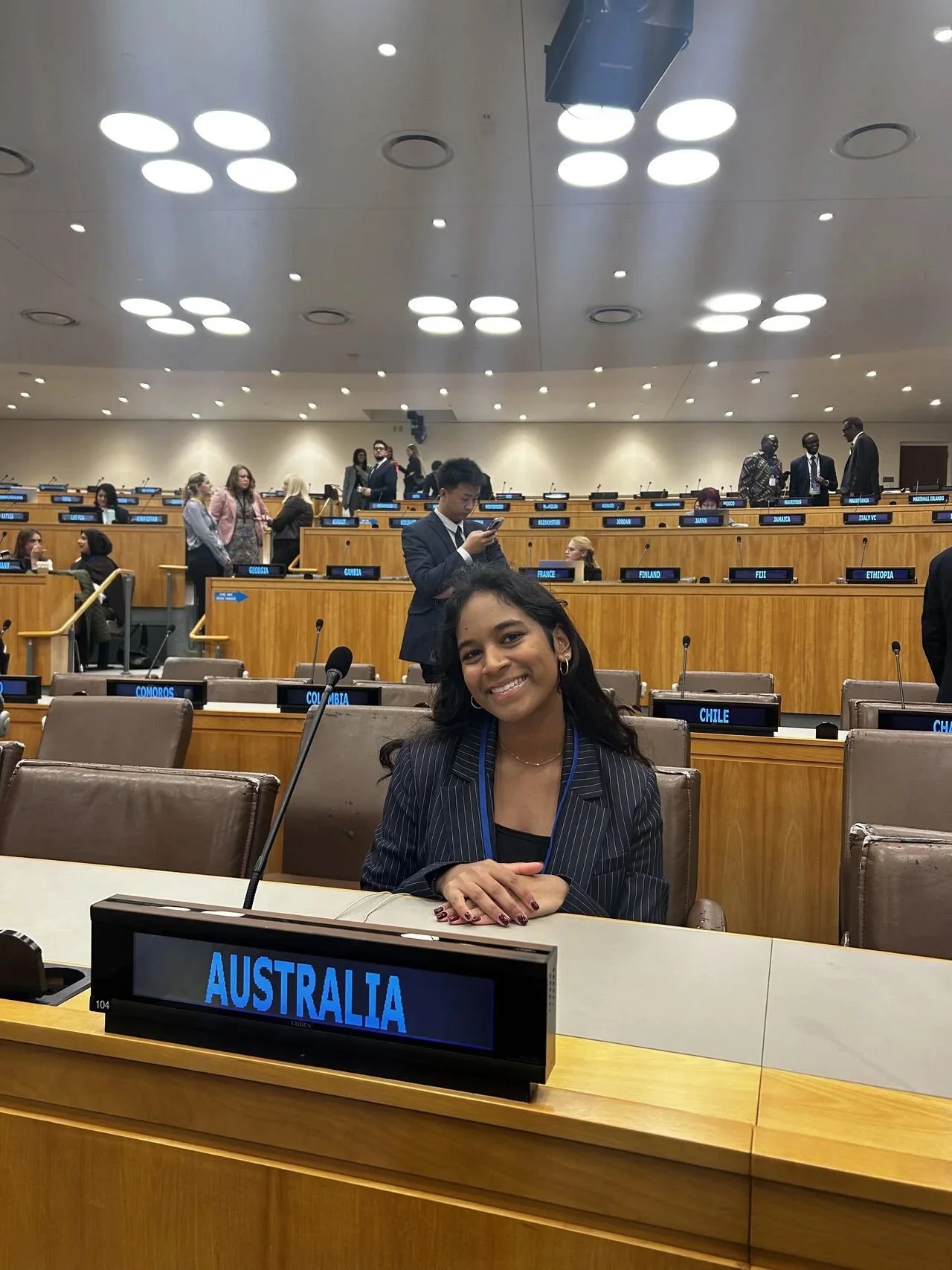
Sydney-based writer Satara Uthayakumaran draws on her Sri Lankan Tamil heritage to reflect on a childhood shaped by migration, silence and embodied communication. Through her bond with her Deaf sister, this essay considers listening as an act of care and resistance – themes that continue to guide her creative practice, including her recent work as Australia’s Youth Ambassador to the United Nations.
Silence has always been the first language of my family. It threaded its way into our home long before I was born – carried across an ocean by my parents, who had left Sri Lanka with stories they could not yet speak aloud. It settled again, years later, in the soft spaces between my sister’s hands and her small, determined body. And it shaped me, the eldest daughter, into the listener, the bridge, the interpreter who lived in the borders between words.
I did not always understand this role. As a child, I stood before my newborn sister’s crib, bewildered by her features that unsettled me: slanted eyes, a button nose, pale skin, nothing like Amma’s (mother’s) mahogany or Appa’s (father’s) burnt date. I had always been called a dark child. I expected my sibling to resemble me. Instead, I felt cheated – confused by a face that did not match the one I had imagined.
Later, I stood beside my parents, deciphering their moods by the way they placed a plate on the table or paused before a sentence that would never arrive. Eventually, without realising, I learned to read all of them in this near-silent dialect – a way of communicating shaped as much by trauma as by love.
One afternoon in December, I sprawled on the couch in my parents’ home, wrapped in the warm rays slipping through the curtains. A shadow emerges. It’s my sister, Karuka, still in her favourite pyjamas – the soft ones with tiny rabbits we bought for Easter. Her hair is tied in a bun, though stray wisps make small rebellions. Without speaking, she begins making figures and signs with the tips of her fingers, then larger motions with her fists until her whole body seems alive with movement.
‘I don’t understand,’ I interrupt, cutting through the reverie of her small afternoon dance.
She slows down, watching the pace of my eyes on her hands. Her movements ebb and swell – like sound waves I cannot hear. When I remain confused, she sighs, retrieves her Auslan cards and arranges them carefully on the table:
I. Want. See. Moon.
I pretend to look confused. Her eyes widened. I grin. “Just kidding – we’ll go this evening.” Her laugh escapes like the chime of a tiny bell.
That night, we drove around our hometown, Wahroonga, through the parks and gorges searching for the moon. Later, I fling myself onto her bed, attacking her with hugs and kisses, which she dutifully wipes back onto me, laughing. Her body is smaller than mine, warm like the human hot-water bottle my mother and I always joke she is. She tucks a loose strand of my hair behind my ear. That is our conversation for the evening – her hands, my face, the quiet language we have built together.
My sister feels the world from a tactile perspective, listening with her whole body to even the smallest shift in movement or breath. This attentive silence is her most fundamental expression of love. And in learning to understand her – long before I understood politics or war or grief – I was already learning how to listen to silence itself.
This was my true inheritance: a sister who taught me that silence is not the absence of meaning but another form of communication altogether. A family that taught me that what is unspoken can be just as powerful as what is said. And a childhood that trained me – gently, insistently – to live in the spaces between words.
What I did not know then was that this early apprenticeship in silence would become the foundation for my life’s work: listening to the testimonies others struggled to voice and carrying them across the fragile threshold into speech. My family taught me that some truths are whispered in gestures, vibrations, or breath; some are held behind clenched jaws; some can be expressed only in song or movement; and some require another person to midwife them into being.
This is the world I was born into – a world where silence was not the absence of language but its most powerful form. A world where I learned to hear without sound, to speak without certainty and to witness what others could not bring themselves to say.
We grew up in communities breathtaking in their warmth – pockets of life stitched together by people who spoke in a dozen different ways—Auslan alongside Tamil, English beside Mandarin and Arabic. Conversations spilled across fences and driveways, threaded with accents, jokes and shared understanding. These were places alive with colour and sound.
So, from my community, I offer an invitation to listen differently – to recognise that communication has always been plural, embodied, relational and that access is not a concession but a recognition of how humans have always made meaning together.
My sister still speaks through her hands. And because of her, I know this: listening is not passive. It is radical. It is an act of care. And in a world structured by selective deafness, it may be the most urgent form of love we have.